Wednesday, January 26, 2022

Russians


I'm fascinated by Russia. I've been trying (not very diligently, I must admit) to learn Russian for a decade now. 

One of the things I find so interesting about a lot of my fellow Americans (not all, but some): they seem to think the rest of the world thinks like we do. They can't fathom people not being in favor of democracy and rights for everyone and freedom to criticize the government without fear of retaliation. It's so bred into our DNA that it's very difficult to understand that it's not the case for the entire world. People are different. We've been raised differently, in different cultures, and with different values. 

Feifer's mother was Russian, his parents met when his father was in Russian doing research for a book he wanted to write. Feifer was able to visit Russian in the early 90s, right after the fall of the Soviet Union, and he's visited quite a few times since. He talks about how ordinary Russians think and feel and do business. How they look at their leaders. One of the things I really liked about this book was that he didn't tar everyone with the same brush. He talked about the fact that some people like things the way they are and others don't. He talked about how some things have changed and yet others have not. A lot of folks miss communism and consider Stalin a great man. It was very interesting. And I promise, someday I will know more than just how to say "goodbye" and "vodka" in Russian :)

Monday, January 24, 2022

The Sound and the Fury


I haven't reread "The Sound and the Fury" in ages, I was long overdue. Hands down one of my favorite books, a brilliant masterpiece. It's a good thing I have a lot of nonfiction on deck, trying to read fiction after TSATF is always disappointing. Nothing can touch it. 

Told in four sections, TSATF follows the Compson family of Jefferson, Mississippi. The first section takes place in 1928 and is told by Benjy, the thirty-three year old youngest son who is intellectually disabled. It was a bold move on Faulkner's part to start the book out with such a confusing narrator, I know it turns a lot of folks off this book since it's not straightforward. Benjy jumps around in time, often in the middle of a sentence, and it can be daunting to stick with it. Well worth it, though. Benjy was very close to his older sister, Candace, known as Caddy. He keeps searching for her, day after day. 

The next section goes back in time to 1910, and is told by Quentin, the oldest son. Quentin's parents sold a pasture to send him to Harvard. Quentin was in love with his sister but couldn't bring himself to commit incest and the fact that his sister had to hastily marry a man she didn't know because she was pregnant with another man's child haunts him to the point where he kills himself. 

The third section is back in 1928 and is told by Jason, my favorite character. Jason was the third Compson child (after Quentin and Caddy). His brother went to Harvard, his sister got married, and Jason was supposed to get a job in a bank Caddy's husband owned, only he divorced her when he discovered she'd tried to trick him into giving her bastard child a name. Caddy sent her daughter, named Quentin after her brother, back home for her parents to raise. A year later her father died, leaving Jason to try to raise her with the help of his mother, who suffers from severe martyr issues, and Dilsey, the Negro cook. I have to admit, I feel sorry for Jason. He got screwed. Dilsey and his mother won't let him discipline Quentin at all, even though she needs it, so she runs wild. Of course Jason does obsess a little, trying so hard to catch her sneaking around. Oh, and he's been stealing the money Caddy sends for her upkeep, so there's that. Still, poor Jason.

The fourth and last section is told by an omnipotent narrator (it's frequently referred to as the Dilsey section). It's Easter Sunday, 1928, and Jason has discovered that he's been robbed. Someone broke the window in his room and made off with his money and Quentin is missing. Not hard to put two and two together on that one. While he's running around, trying to get the sheriff involved, Dilsey takes Benjy and her grandson, Luster (who is Benjy's current minder) to church. Dilsey reluctantly allows Luster to drive the carriage so Benjy can have his once a week outing, but when Luster doesn't turn the right way Benjy freaks out in the middle of the square. Jason sees it and comes running over, appalled that his brother is acting out in public. He rights the carriage, going the correct way and Benjy immediately calms down. All is right in his world again. And that's the end :)

Years later, Faulkner wrote an appendix which sort of tied some things up. A librarian finds a picture in a magazine of Caddy, in Europe with a Nazi officer. She shows it to Jason, who doesn't care, and then tracks down Dilsey in Memphis at her daughter's house, but Dilsey is nearly blind and can't see the picture. Caddy was always doomed, right from the start. We learn that Caroline died in 1933 and Jason shipped Benjy off to the state hospital in Jackson and sold what was left of the family house, moving into town. And thus ended the Compsons. 

Killer by Design


Dr. Burgess was an integral part of the beginning of the Behavioral Science Unit of the FBI, working alongside profilers like Robert Ressler and John Douglas. Together they studied serial killers and helped local law enforcement catch others, like BTK and the Unabomber. It was interesting to see Ann's approach (from a more clinical point of view) versus books by John Douglas that I've read. And that was one of the points she made in this book, about why it was so important to have a team of profilers: everyone came at the problem with a different viewpoint and together they were stronger.  

Tuesday, January 18, 2022

Slewfoot; Ever Fallen In Love


I really enjoyed this one! How have I never heard of Brom before? I came across it completely by chance in the receiving room at my library, saw it on the cart and went "ooh, that looks like fun!". And it was.

Set in 1666 in Connecticut, Abitha, who is recently widowed, is trying to save her husband's farm, working the land herself. Her brother in law, Wallace, is trying to sabotage her at every turn so he can take the farm for himself. Abitha meets a creature called "Father", a half-man, half-goat beast who seems like a Godsend. He keeps her safe and helps her tap into the magic inside herself. With Father's help, her crops grow and she is able to pay off her debt to Wallace. This ignites his anger and he has Abitha arrested and tried as a witch. It was super creepy and tense. 


I bought this book thinking it was more a traditional biography about Pete Shelley and Buzzcocks, but it was actually a series of interviews Pete did with Louie before he passed away in 2018. Louie (not related to Pete) was apparently a *giant* Buzzcocks fan (she tried to make the case that Buzzcocks were better than the Beatles--quite a stretch, but I give her credit for her effort!) and asked Pete about the origin of each of the songs from Buzzcocks' earlier albums, before they broke up in the early 80s. I don't know if she would have gotten to their newer material if she'd had more time to interview him. It was a shame she didn't, because their 2003 album is my favorite. For hardcore Buzzcocks' fans, this book is a treasure. For a more casual fan like myself who doesn't have their entire catalog memorized, it was a bit boring. Still, Pete seems like he was a nice, intelligent guy and it's a shame he passed away so young. 


Wednesday, January 12, 2022

Great Circle


I really loved this book--at least the first half or so.

It had such a great beginning. Switching back and forth between Marian Graves, a female pilot in the 1930s and 40s who disappeared and was presumed lost after attempting to circle the globe from pole to pole, and Hadley, an actress in present day Hollywood, attempting to save her career after some major mistakes, who is cast to play Marian in a biopic. 

Marian and her twin brother, Jamie, were sent to Montana to live with their uncle Wallace after their mother vanishes and their father is sent to prison. Marian and Jamie pretty much raise themselves (Wallace is a gambler prone to drinking too much, a nice enough guy, but definitely not parent of the year material). Marian develops an early interest in flying and catches the eye of a bootlegger named Barclay. She has no interest in Barclay, but she does accept his offer of paying for flying lessons, with the caveat that she can run illegal booze in from Canada for him once she's able to fly on her own. 

Hadley's parents were killed in an airplane crash when she was little and she too was sent to her uncle Mitch, who was a lot like Wallace. She got into acting early and landed a plum role on a teen show, then as the lead in a series of supernatural romance films (I'm guessing a "Twilight" meets "Fifty Shades of Grey" sort of thing based on the description). She gets booted from the franchise for "not protecting the brand" (daring to have a life of her own) and is intrigued by her neighbor's suggestion that she audition for the role of Marian. Hadley read Marian's book when she was a little girl and felt draw to the pilot. 

And then we come to the second half and it felt like I was reading a completely different book. The first part was so richly detailed and the second part just felt glossed over and rushed. It was disappointing, considering it was almost 600 pages long. The balance could have been better, I think. And the ending was so clichéd it was almost painful. It's too bad, after such a great start, by the time the book turned I had invested too much time not to finish it. 

Monday, January 3, 2022

Boys Enter the House


I *really* wanted to like this book. I read Tim Cahill's "Killer Clown" about John Wayne Gacy years ago, not long after I read "Helter Skelter". I was horrified by the idea that he buried the bodies under his own house, with his wife and stepkids living there. He really led a double life, playing the clown on the weekends to sick kids in the hospital, murdering young men at night. Very creepy stuff. 

That being said, I didn't like this book. I loved the idea of putting the focus on the victims rather than Gacy. These young men had lives, families, friends, people who cared about them and worried about them when they didn't come home, searched for them for years, and mourned them when their bodies were pulled out of the muck under Gacy's house. Unfortunately, Nelson's writing style was very confusing. There were almost three dozen victims, and without a single picture to help put a name to a face, it was nearly impossible to keep everyone's story straight. It didn't help that a lot of these young men knew each other, grew up in the same neighborhood. I think the simple addition of pictures of each victim would have gone a long way to helping me. Nevertheless, I'm glad he told their stories. Such a tragedy. I just wish it would have been done a little bit better.

Tuesday, December 28, 2021

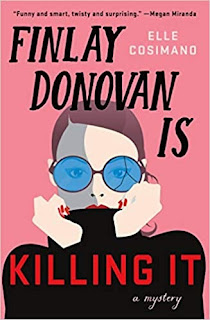
Finlay Donovan is Killing It


I loved this book. It was hysterical. It reminded me a lot of the early Stephanie Plum books, where Stephanie would just get into these crazy mix-ups. Finlay is very similar. 

Finlay is a single mom of two whose soon to be ex-husband is engaged to Theresa, a real estate agent. Theresa and Steven are not making it easy on Finn. She's up to her eyeballs in bills and trying to take care of two little kids while working on her book. She's way, way past her deadline, as her agent keeps reminding her. Finlay goes to a local Panera to meet her agent to discuss pushing back the deadline or perhaps getting a little more advance money, and the answer to both is a hard "no". When Finlay gets home she discovers a note in her diaper bag with a phone number on it. Curious, she calls and talks to Patricia, who was sitting next to her at Panera and overheard her conversation with her agent. Patricia would like to hire Finlay to murder her husband, Harris. 

Finlay is shocked and tries to explain to Patricia that she misunderstood the conversation: she didn't mean *that* kind of contract. But Patricia is stubborn and insists Finlay can do it, and what's more is she'll pay: $50,000. 

Curious as to why Patricia would want her husband dead, Finlay goes out to a bar in disguise and sees Harris in action. When he slips a roofie in his date's drink, Finlay waylays her in the restroom, "accidentally" spills a drink on her, then joins Harris and manages to switch cocktails, getting him to drink the drugged one. She gets him out of the bar and into the back of her van before he passes out, but now what? Not sure what else to do, she takes him home. She leaves him in the back of the van while she goes upstairs to change and when she returns, he's dead: choked on the exhaust fumes because she left the van running and the garage door is closed. Only...she didn't close it. Someone else killed Harris. 

I don't want to recap the whole thing, but as you can imagine, it spirals from there. Finlay gets deeper and deeper into the mess she created and can't figure a way out. It doesn't help that when she writes about what happened (using fake names, of course) and sends it to her agent, she loves it and is able to sell it for a $150,000 advance. A hot cop plus a hot bartender/law student and a terrific nanny/accountant sidekick round out the cast of characters. I'm excited there's a sequel. Too much fun.